How SUHO Guided Development WA Toward Lower-Carbon, Higher-Performing Homes
Development WA engaged SUHO to develop an evidence-based design guideline to support large-scale residential delivery, informing up to 1000 homes per year. The purpose of the study was to reduce the overall carbon footprint and greenhouse gas emissions associated with residential development, with a particular focus on understanding and minimising embodied carbon alongside operational performance outcomes. Using a typical residential dwelling as a test case, SUHO assessed how construction methods, energy-efficiency targets, and specification choices influence operational cost, operational carbon, thermal performance, thermal comfort, embodied carbon, and the pathway to achieving Net Zero carbon.
SUHO's Residential Consulting team utilised its in-house Optimisation Service, which tests different approaches and ensures a personalised approach to enhance energy efficiency, compliance, and comfort. The service provides comprehensive analysis packages, including energy consultancy and Net Zero assessments, enabling homeowners and project teams to make informed design decisions to tailor their upgrade options. In addition to the Optimisation of Energy Efficiency, SUHO calculated material-level emissions for three different construction methods using the EPiC embodied carbon database. Each modelled at both 6-star and 8-star NatHERS ratings. This created six distinct scenarios, allowing a clear comparison of the carbon implications between lightweight, medium-weight, and heavyweight construction systems, and how the additional materials required to reach an 8-star rating influence the embodied carbon profile.
The three construction types assessed represented a broad spectrum of contemporary residential building practice.
- Option 1 reflected a lightweight approach using steel framing, timber flooring, a metal roof, and weatherboard cladding.
- Option 2 adopted a medium-weight system built around a concrete slab, timber framing, and a metal roof.
- Option 3 represented a heavyweight system featuring brick cavity walls, the most common choice for WA, a concrete slab, and a tiled roof.
Modelling these different typologies at both 6 and 8 stars allowed SUHO to capture not only how each construction system behaves environmentally, but also how improvements to the thermal shell requires upgrades in material specification, which typically affects the associated carbon emissions.
Across all scenarios, the results revealed clear patterns in how different materials contribute to embodied carbon. In lightweight construction, glazing emerged as the dominant carbon hotspot, contributing approximately one-third of total embodied emissions. In medium-weight construction, the concrete slab was responsible for a similar share, highlighting how the introduction of concrete significantly increases the carbon intensity of the home. In heavyweight construction, brick cavity wall systems were the single largest contributor, accounting for roughly 25% of total embodied emissions and reinforcing the known emission intensity of masonry-dominant structures. Regardless of these differences, glazing remained a consistently large contributor across all construction types and star ratings, underscoring the carbon cost of achieving high-performance thermal envelopes.
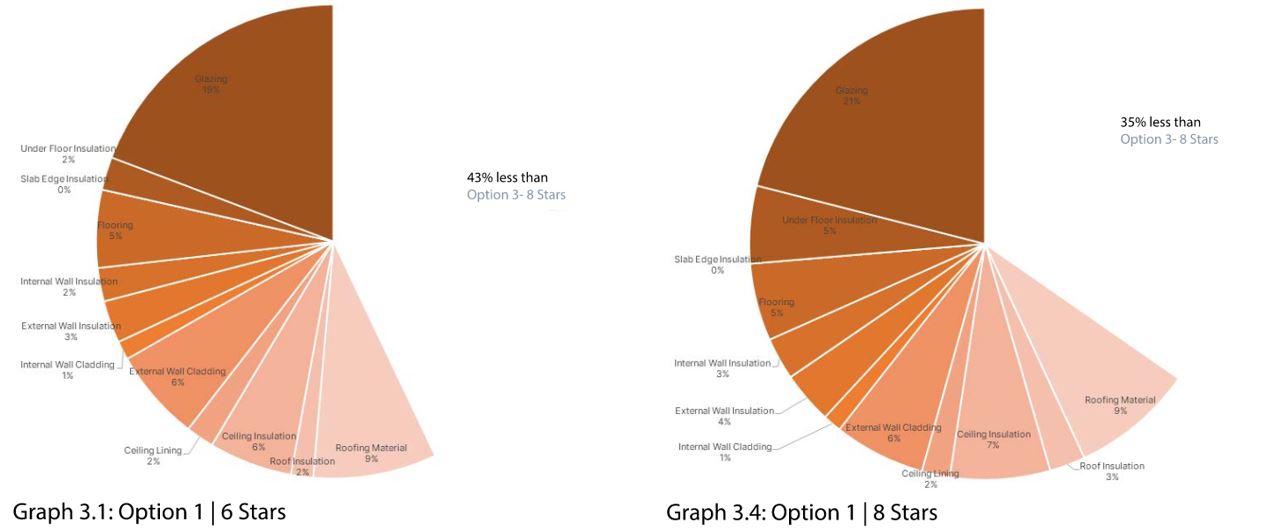
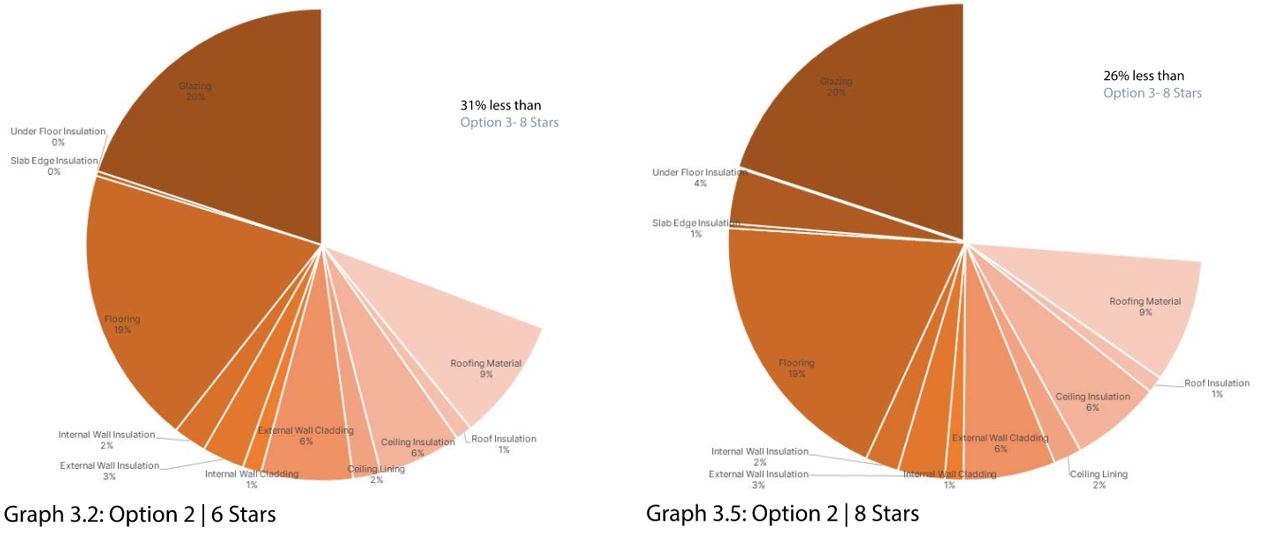
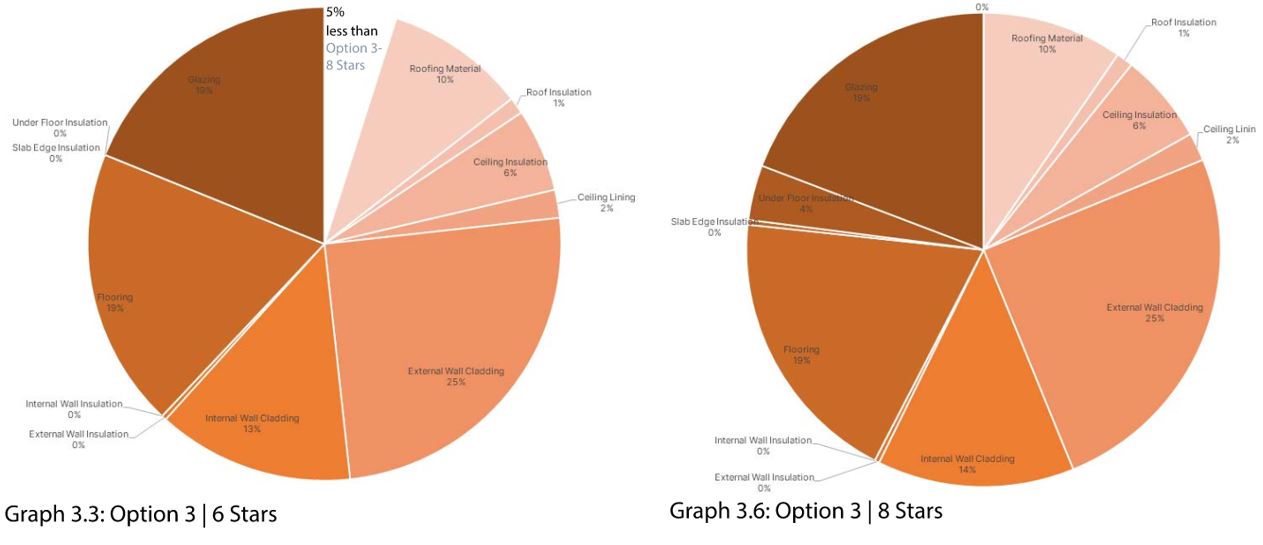
A particularly important finding for Development WA was the impact of upgrading each construction type from 6 stars to 8 stars. Although achieving an 8-star rating requires additional insulation, enhanced glazing performance, and improved envelope specifications, the overall increase in embodied carbon was found to be relatively small. In most cases, the uplift in carbon intensity was marginal when compared with the total embodied emissions of the dwelling. This means that the environmental “cost” of going from 6 stars to 8 stars is minimal in embodied-carbon terms, while the benefits of improved thermal performance, occupant comfort, and long-term energy efficiency, including operational emissions and cost reductions, are significant.
The study also highlighted the pathway to achieving Net Zero carbon. By modelling operational energy alongside embodied carbon, SUHO was able to estimate the payback period for the carbon footprint and identify how appliance selection can significantly influence operational carbon. One key finding was that choosing high-efficiency appliances plays a very large role in reducing operational carbon. For example, a medium-weight dwelling (Option 2) upgraded to 8 stars could achieve a carbon payback period of 10–14 years, depending on the size and output of on-site renewable energy systems, such as solar panels. Across the scenarios assessed, the combined impact of improved envelope performance and efficient appliances demonstrates that the costs of early investment in low-carbon strategies can be recouped relatively quickly in emissions terms.
By delivering detailed material-level insights, breakdown charts, and clear explanations, SUHO provided Development WA with a strong evidence base for decision-making. The embodied-carbon comparisons clarified the trade-offs between lightweight, medium-weight, and heavyweight systems: lightweight systems showed the lowest upfront carbon, medium-weight systems carried moderate embodied emissions, and heavyweight systems were the most carbon-intensive. SUHO’s reporting illustrated the dominant contributors for each archetype at both 6-star and 8-star ratings, allowing stakeholders to see how glazing, concrete slabs, and brick walls drive the overall footprint. Importantly, the 8-star analysis confirmed that the additional materials needed for higher performance add only a marginal increase in embodied carbon. This nuanced understanding allowed Development WA to confidently pursue higher-performance designs without a prohibitive carbon penalty. Together, these insights positioned Development WA to adopt construction approaches that balance carbon, comfort, and long-term sustainability outcomes, impacting potentially 1000 residential homes per year and amplifying the environmental benefits at scale.
This project highlights the strength of SUHO’s Optimisation Service, demonstrating its ability to analyse complex design variables, quantify environmental impacts, and translate technical modelling into simple, actionable recommendations. By focusing on embodied carbon and material impacts, SUHO helped Development WA move toward a design pathway that supports lower-carbon construction while still achieving high performance and future-ready homes.